
-
 Free Shipping Over $250
6" Black Single Wall Stove Pipe — Stove Connector
Vendor:DroletRegular price $18.50 USD -
 Free Shipping Over $250
6" Black Single Wall Stove Pipe — 12" Length
Vendor:DroletRegular price $18.50 USD -
 Free Shipping Over $250
Vortex Wall Finishing Band 6" — VOD0150
Vendor:VortexRegular price $19.00 USD -
 Free Shipping Over $250
6" Black Single Wall Stove Pipe — 18" Length
Vendor:DroletRegular price $22.00 USD -
 Free Shipping Over $250
6" Black Square Wall Trim Collar
Vendor:DroletRegular price $25.00 USD -
 Free Shipping Over $250
6" Black Single Wall Stove Pipe — 45° Elbow
Vendor:DroletRegular price $29.00 USD -
 Free Shipping Over $250
6" Black Round Wall Trim Collar
Vendor:DroletRegular price $29.00 USD -
 Free Shipping Over $250
6" Black Single Wall Stove Pipe — 24" Length
Vendor:DroletRegular price $32.00 USD -
 Free Shipping Over $250
6" Black Single Wall Stove Pipe — Cap
Vendor:DroletRegular price $33.00 USD -
 Free Shipping Over $250
Vortex Vented Stove Adapter 6" — VOD0290
Vendor:VortexRegular price $35.00 USD -
 Free Shipping Over $250
Vortex Stove Adapter 6" — VOD0291
Vendor:VortexRegular price $35.00 USD -
 Free Shipping Over $250
6" Black Single Wall Stove Pipe — 36" Length
Vendor:DroletRegular price $37.00 USD -
 Free Shipping Over $250
6" Black Single Wall Stove Pipe — 90° Elbow
Vendor:DroletRegular price $37.00 USD -
 Free Shipping Over $250
Vortex Double Wall Black Pipe 6" x 12"L — VOD0004
Vendor:VortexRegular price $39.00 USD -
 Free Shipping Over $250
6" Black Single Wall Stove Pipe — Section with Damper
Vendor:DroletRegular price $45.00 USD -

 Free Shipping Over $250
Vortex Double Wall Slip Section 6" x 6"L — VOD0075
Vendor:VortexRegular price $49.00 USD -
 Free Shipping Over $250
Vortex Double Wall Black Pipe 6" x 18"L — VOD0007
Vendor:VortexRegular price $59.00 USD -

 Free Shipping Over $250
Vortex Double Wall Slip Section 6" x 12"L — VOD0076
Vendor:VortexRegular price $59.00 USD -

 Free Shipping Over $250
Vortex Double Wall Slip Section 6" x 18"L — VOD0077
Vendor:VortexRegular price $69.00 USD -
 Free Shipping Over $250
6" Black Single Wall Stove Pipe — Tee with Cap
Vendor:DroletRegular price $75.00 USD -
 Free Shipping Over $250
6" Black Single Wall Telescopic Stove Pipe — 38"–70"
Vendor:DroletRegular price $79.00 USD -
 Free Shipping Over $250
Vortex Double Wall Black Pipe 6" x 36"L — VOD0013
Vendor:VortexRegular price $89.00 USD -

 Free Shipping Over $250
Heat Shield Kit for 6" Black Single Wall Stove Pipe — To The Ceiling
Vendor:SBIRegular price $99.00 USD -
 Free Shipping Over $250
Vortex Double Wall Telescoping Section 6" 18"–30" — VOD0050
Vendor:VortexRegular price $119.00 USD -
 Free Shipping Over $250
6" Black Single Wall Stove Pipe Kit — To The Ceiling
Vendor:DroletRegular price $149.00 USD -
 Free Shipping Over $250
6" Black Single Wall Stove Pipe Kit — To The Wall
Vendor:DroletRegular price $229.00 USD -
 Free Shipping Over $250
6" Black Single Wall Telescopic Stove Pipe — 14"–22"
Vendor:DroletRegular price $37.00 USDBackorder -
 Free Shipping Over $250
Vortex Double Wall Black Pipe 6" x 6"L — VOD0001
Vendor:VortexRegular price $37.00 USDBackorder -
 Free Shipping Over $250
Vortex Double Wall Black Pipe 6" x 24"L — VOD0010
Vendor:VortexRegular price $65.00 USDBackorder -
 Free Shipping Over $250
45° Elbow 6" Vortex Double Wall — VOD0090
Vendor:VortexRegular price $69.00 USDBackorder -
 Free Shipping Over $250
Vortex Double Wall Stove Pipe Section with Damper 6" — VOD0190
Vendor:VortexRegular price $75.00 USDBackorder -
 Free Shipping Over $250
90° Elbow 6" Vortex Double Wall — VOD0093
Vendor:VortexRegular price $79.00 USDBackorder -

 Free Shipping Over $250
Vortex Double Wall Masonry Adapter 6" — VOD0230
Vendor:VortexRegular price $85.00 USDBackorder -
 Free Shipping Over $250
Vortex Double Wall Black Pipe 6" x 48"L — VOD0016
Vendor:VortexRegular price $105.00 USDBackorder -
 Free Shipping Over $250
Vortex Double Wall Tee with Cap 6" — VOD0110
Vendor:VortexRegular price $119.00 USDBackorder -
 Free Shipping Over $250
Vortex Double Wall Telescoping Section 6" 28"–50" — VOD0053
Vendor:VortexRegular price $145.00 USDBackorder -
 Free Shipping Over $250
Vortex Double Wall Telescoping Section 6" 40"–68" — VOD0056
Vendor:VortexRegular price $175.00 USDBackorder -

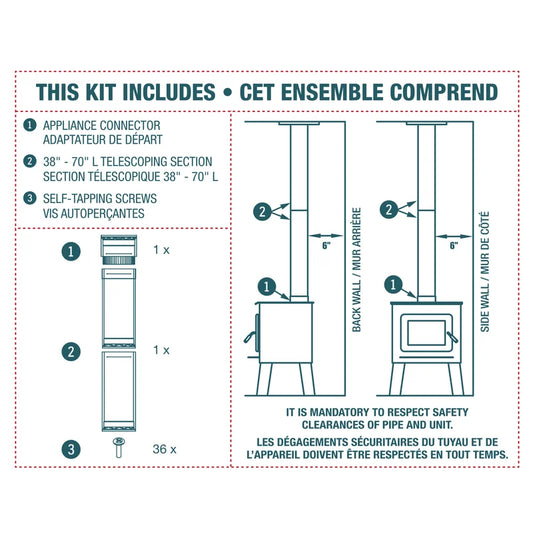 Free Shipping Over $250
To-The-Ceiling Double Wall Stove Pipe Kit 6" — VODBKTC06
Vendor:VortexRegular price $219.00 USDBackorder -

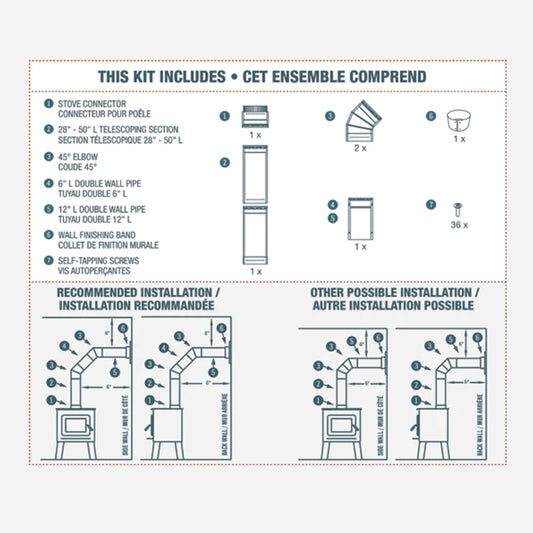 Free Shipping
To-The-Wall Double Wall Stove Pipe Kit 6" — VODBKTW06
Vendor:VortexRegular price $359.00 USDBackorder


Stoves, liners, and pellet venting
This connector pipe is what links a freestanding wood stove to its chimney. If you're venting a wood insert inside an existing masonry fireplace instead, you need a stainless chimney liner rather than stove pipe. Pellet stoves use their own sealed pellet vent pipe, which is not interchangeable with wood stove pipe. When in doubt, match the pipe to the appliance on its product page.
What you'll need for installation
Single-wall pipe requires 18" of clearance to combustible walls and ceilings; double-wall pipe reduces that and gives a cleaner look, so it's the usual choice in a tight alcove — the exact figures are printed in your stove's owner's manual and our clearance guide. You'll also want a hearth pad under the stove and, for most installs, a damper section to control draft. Our wood stove installation guide covers the full sequence from stove to cap.
Stove pipe FAQs
Do I need a through-the-wall or through-the-roof kit?
Through-the-roof means the pipe runs straight up and out the roof on a vertical Class A chimney — it drafts best and is the default where the stove sits under an accessible roofline. Through-the-wall means the pipe turns out an exterior wall on a tee and rises up the outside of the house, which is easier when a straight vertical run isn't practical. Pick the kit that matches your route; both start with the connector pipe sold here.
What's the difference between single-wall and double-wall stove pipe?
Single-wall pipe is less expensive but needs 18" of clearance to combustibles. Double-wall pipe has an insulating air gap, so it can sit closer to walls and ceilings, keeps flue gases warmer for better draft, and looks cleaner. Both are sold here in 6".
What size stove pipe do I need?
Match the pipe to the stove's flue collar — 6" fits the large majority of wood stoves, including every Drolet and Englander model we sell. Check the flue outlet size on your stove's product page or manual before ordering.
Can I run stove pipe horizontally out through the wall?
Yes — a through-the-wall kit uses a tee to turn the run horizontal through the wall, then transitions to Class A chimney that rises up the outside. There are limits on horizontal length and required vertical rise for proper draft; follow the kit instructions and your stove's manual.
Is stove pipe the same as chimney pipe?
No. Stove pipe (the black connector pipe here) runs only from the stove to the ceiling or wall. The part that passes through the roof or wall and up the outside is insulated Class A chimney — a different, listed component. Connector pipe is never used as the chimney itself.
Do you charge sales tax on venting?
No. StoveSource charges no sales tax in any state, and orders over $250 ship free to the lower 48.