
-
 Free Shipping Over $250
6" Black Single Wall Stove Pipe Kit — To The Ceiling
Vendor:DroletRegular price $149.00 USD -
 Free Shipping Over $250
6" Black Single Wall Stove Pipe Kit — To The Wall
Vendor:DroletRegular price $229.00 USD -

 Free Shipping Over $250
Heat Shield Kit for 6" Black Single Wall Stove Pipe — To The Ceiling
Vendor:SBIRegular price $99.00 USD -
 Free Shipping Over $250
6" Black Single Wall Stove Pipe — Tee with Cap
Vendor:DroletRegular price $75.00 USD -
 Free Shipping Over $250
Vortex Wall Finishing Band 6" — VOD0150
Vendor:VortexRegular price $19.00 USD -
 Free Shipping Over $250
6" Black Round Wall Trim Collar
Vendor:DroletRegular price $29.00 USD -
 Free Shipping Over $250
6" Black Square Wall Trim Collar
Vendor:DroletRegular price $25.00 USD -

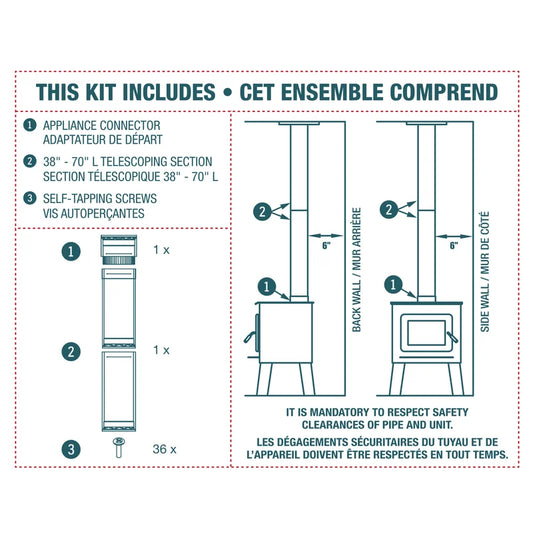 Free Shipping Over $250
To-The-Ceiling Double Wall Stove Pipe Kit 6" — VODBKTC06
Vendor:VortexRegular price $219.00 USDBackorder -

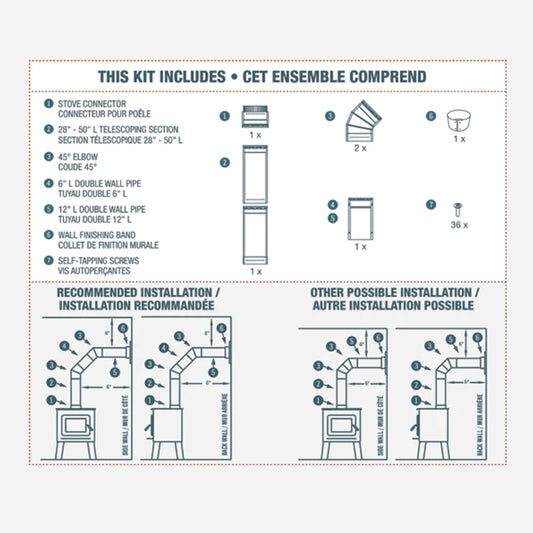 Free Shipping
To-The-Wall Double Wall Stove Pipe Kit 6" — VODBKTW06
Vendor:VortexRegular price $359.00 USDBackorder -
 Free Shipping Over $250
Vortex Double Wall Tee with Cap 6" — VOD0110
Vendor:VortexRegular price $119.00 USDBackorder -

 Free Shipping Over $250
Vortex Double Wall Masonry Adapter 6" — VOD0230
Vendor:VortexRegular price $85.00 USDBackorder


What a pipe kit includes — and what it doesn't
A wood stove pipe kit is the connector run only: the black pipe from the stove's flue collar to the wall or ceiling. That is the part you see in the room, and it is the part these kits cover completely.
What no kit here includes is the chimney itself. Once the flue passes through a wall or a ceiling it must become Class A insulated chimney, along with the support box, firestop, flashing and storm collar that go with it. We do not stock Class A chimney, so you will source that separately from a local supplier or a big-box store. We would rather tell you that up front than have you open the box and find half a job.
Through the wall or through the roof?
The route is usually decided by the building, not by preference.
Straight up through the ceiling is the better-performing option and the cheaper one. A vertical flue drafts naturally, stays warmer, and builds less creosote. Choose it when the stove sits against an interior wall or in a room where the flue can run up through the storey above and out the roof. The SP00370 single wall kit at $149 and the VODBKTC06 double wall kit at $219 both cover this run.
Out through an exterior wall is what you use when there is no clean vertical path — a cathedral ceiling, a bedroom directly above, or a stove on an outside wall. The pipe turns 90 degrees, exits the wall, and then climbs the outside of the house as Class A chimney. It costs more, needs a tee with a clean-out cap at the base, and drafts less willingly in cold weather because the outside chimney runs cold between fires. The SP00360 and VODBKTW06 kits handle this run.
If you have a genuine choice between the two, go up. The horizontal exit is a solution to a constraint, not an upgrade.
Single wall or double wall
This decision is about clearance, and it usually pays for itself.
| Single wall | Double wall | |
|---|---|---|
| Clearance to combustibles | 18" from the pipe | 6" from the pipe |
| Kit price (6", to the ceiling) | $149 | $219 |
| Heat into the room | More — the pipe itself radiates | Less — the air gap insulates |
| Best for | Open rooms with space around the flue | Tight rooms, corners, alcoves |
The 12" difference in clearance is what decides most installations. If your stove is going into a corner or an alcove, double wall connector pipe will often be the only thing that makes the position legal without building a shielded wall. If the room is open and the flue has 18" of air around it on all sides, single wall is cheaper and throws a little more heat.
One middle path: the SP00390 heat shield kit at $99 clips onto a single wall to-the-ceiling run and reduces its clearance requirement. Cheaper than stepping up to double wall if you have already bought single wall pipe.
What you still need to buy
Beyond the kit and the Class A chimney, budget for these:
- Floor protection. Nearly every wood stove requires a non-combustible pad under and in front of it. See our hearth pads.
- A tee with a clean-out cap if you are going out through a wall — the VOD0110 for double wall or the SP00110 for single wall.
- A wall trim collar or finishing band to close the gap where the pipe meets the wall — the VOD0150, or the round SP00150 and square SP00170 collars.
- A masonry adapter if you are connecting into an existing masonry chimney rather than a new Class A run — the VOD0230. In that case you will also want a stainless chimney liner.
Common questions
Does a wood stove pipe kit include the chimney?
No. Every kit on this page covers the connector pipe inside the room only. Class A insulated chimney, the support box, firestop, flashing and storm collar are all separate, and we do not carry them.
What size pipe kit do I need?
Six inch, for every Drolet and Englander wood stove we sell. Match the kit to the stove's flue collar, never to the chimney — reducing or enlarging the connector diameter changes how the stove drafts and voids most certifications.
Can I run single wall pipe through a wall or ceiling?
No. Connector pipe of either type stops at the wall or ceiling. The penetration itself has to be made with Class A chimney through a listed support box or thimble.
Is a through-the-wall install harder than going up through the roof?
It is more parts and more money, and it drafts less readily in cold weather, but it avoids cutting through a finished ceiling and roof. Most people choose it because the vertical route is blocked, not because it is easier.
Do you charge sales tax on stove pipe?
No. StoveSource charges no sales tax in any state, and orders over $250 ship free to the lower 48.
Not sure which route your house allows? Call 1-888-914-0022 with your stove model and a rough description of where it is going and we will talk it through before you order.